bennpitman.html
|
|
Selections |

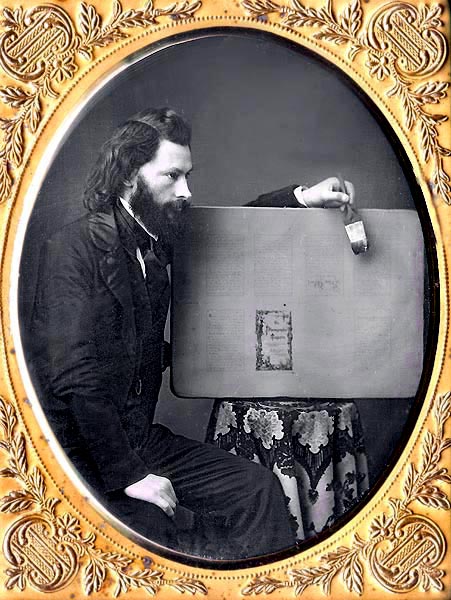
Unidentified photographer (U.S., probably Cincinnati, Ohio) Benn Pitman with Printing Plate for The Phonographic Magazine.
Quarter-plate daguerreotype, circa 1856.
Benn Pitman (1822-1910) was the brother of Sir Isaac Pitman, inventor of a system of phonetic shorthand. Benn Pitman moved to the United States in 1852, the same year he founded the Phonographic Institute in Cincinnati to teach and promote his brother’s stenographic system in the U.S.. Within 40 years, 90% of all American stenographers were using the Pitman shorthand method.
The Phonographic Institute published dozens of books, many written by Benn Pittman. His most famous publication, however, resulted from serving as Chief Court Reporter of the military tribunal that tried the Lincoln assassination conspirators. Organizing and condensing thousands of pages of testimony, he published THE ASSASSINATION OF PRESIDENT LINCOLN AND THE TRIAL OF THE CONSPIRATORS.COMPILED AND ARRANGED BY RECORDER TO THE COMMISSION (Cincinnati: Moore, Wilstach & Baldwin) in 1865.
In 1873 Pitman began teaching decorative arts at the Cincinnati Art Academy, where he was an early advocate of women in the arts. Three years later, at the Centennial Exposition in Philadelphia, he organized an exhibit of Arts and Crafts by women and girls that included woodcarving, china painting and needlework. Among the furniture designed by Benn Pitman and produced in Cincinnati is a carved bedstead (now in the Cincinnati Art Museum) considered “one of the finest examples of American Aesthetic movement furniture ever produced.”
The Phonographic Magazine commenced publication in 1854, offering articles printed in Pitman shorthand. In 1855, Benn Pitman invented (but chose not to patent) an electrochemical process of relief engraving for which he was awarded a silver medal by the Mechanics Institute in 1856. Presumably, the printing plate shown in this daguerreotype was produced by that electrotype process, as a lithography stone of the same size would have been far too heavy to be displayed with the support shown in the image.
Like most daguerreotypes, this portrait was bereft of documentation when acquired. The identification was made on the basis of the title page on the printing plate (the only page comprehensible to those who do not read shorthand) and it was confirmed by comparison with later portraits of Benn Pitman.
Wm. B. Becker
Copyright © 2002 The American Photography Museum, Inc. All Rights Reserved.