Edward L. Wilson was an influential photographer, critic and editor and an early campaigner for the recognition of photography as art. He is best known as the founding editor of the journal The Philadelphia Photographer, and for co-founding the Centennial Photographic Company which held the concession for photography at the 1876 Exposition in Philadelphia.
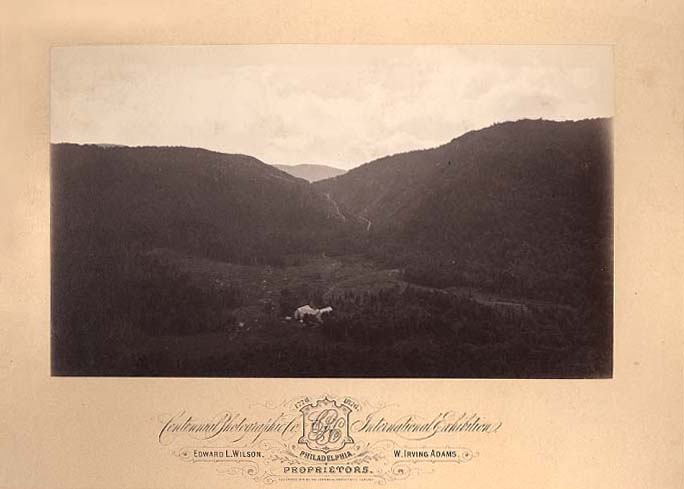
Wilson’s personal work as a photographer is not well known. Two recently-discovered images, however, provide a tantalizing glimpse of his talent as a landscape artist. They were found on engraved mounts of the Centennial Photographic Company, which carry both Wilson’s name and that of a partner in the enterprise, W. Irving Adams. Clearly these images do not show scenes from the Centennial; a third image from the group enabled the location to be determined. It is Dixville Notch, New Hampshire, a tiny hamlet best known today for being the first community in the nation to cast and count its ballots in presidential elections.
With that clue, Wilson scholar Sarah J. Weatherwax was able to provide documentary evidence of Wilson’s authorship of these images, in the form of a series of articles in The Photographic Times. The first of these articles is a brief column published in the October, 1880 issue, headed “Matters of the Month”:
We have received from our friend Mr. Edward L. Wilson, Philadelphia, Pa., an elegant set of views of the Dixville Notch, New Hampshire, made by himself on Newton’s Emulsion Dry Plates and gelatino-bromide dry plates, during his vacation this summer. The point of view in every case is most admirably selected. The lights and shades are exquisite in detail, the grand old rocks standing up in bold relief against the soft sky and amid the luxurious foliage.
In some of them, groups of climbers are judiciously dispersed, the action or careless repose of the figures giving life and animation to the rugged background. The negatives were made at all hours of the day. Our friend evidently kept his eyes open and took advantage of favorable effects with artistic attention. His care, taste, skill, and judgment are pre-eminently shown in every picture, and we are pleased with every one.
As samples of dry-plate work they are a triumphant success and with such specimens as these before us we feel safe in prognosticating a brilliant future for emulsion. “They are as good as wet” says the maker of the views. These pictures were exhibited at the Photographic Association Convention, Chicago.
Mr. Wilson is a firm believer in Morrison Lenses and American Optical Company’s apparatus, both of which he used exclusively. He used a No. “C” lens for the groups and a six-inch focus view lens for the landscapes. He is even more enthusiastic in his praises of those goods than we find words to express in admiration of his work. He has astonished us.
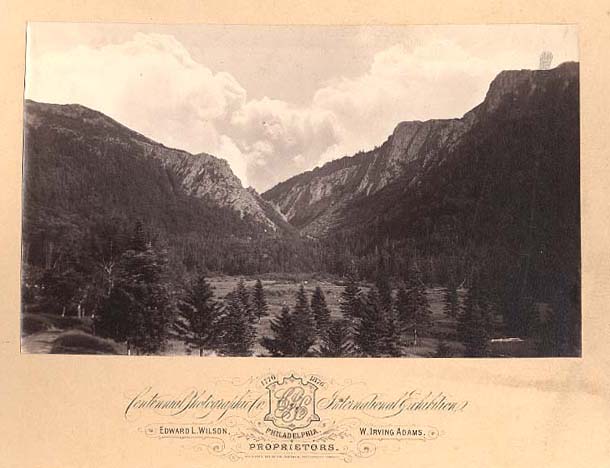
Edward L. Wilson wrote a separate account of the trip to Dixville Notch for his own magazine, The Philadelphia Photographer. He describes one photograph (perhaps the image shown above) as depicting
…the gates of Dixville Notch from the hotel piazza, second floor. The grove of pines in the foreground is near to the piazza. The highest point on the right is the “Gloriette;” the second is the “Old King,” whose rounded forehead, snubbed nose, and parting lips can be fairly seen. Between these rugged peaks which form this view, for the distance of near a mile, are what look like sleepy mounds. Upon the rugged sides thereof are to be found the choicest bits for the camera…
Wilson’s expedition to the rugged area around the Notch was a turning point for American photography, for it signalled the end of the wet-plate era — a time when photographers needed to carry a complete darkroom outfit and chemicals wherever they traveled. Now, Wilson endorsed the use of dry plate negatives that did not require chemical processing on the spot:
No one resisted the adoption of dry plates more obdurately than we. Our results this summer have convinced us of their value, and we say what we do freely, and after experience had. Our success is all due to the plates used and to our unequalled apparatus… The clouds, of course, are natural but printed in.