Resources
RESOURCESA Primer on ProcessesScroll down for an alphabetical listing of photographic processes ———- |
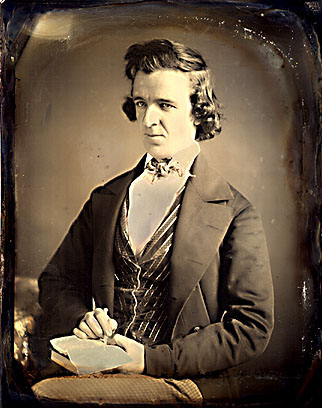
Daguerreotype by an unidentified photographer 3-1/4″ x 4-1/4″ circa 1845 |
A PRIMER ON PROCESSES
Photographers in the nineteenth century employed a wide variety of materials and processes; everything from honey to uranium found its way into one method or another. In some cases there is no way to tell, short of exacting scientific analysis, just what sort of variation was used to obtain a specific result. Most early photographs, however, fall into recognizable categories for which brief descriptions follow in alphabetical order.
Albumen prints outnumber any other type of photographic positive made during the nineteenth century. They have a sepia color and slightly glossy surface. Thin sheets of paper were first coated with egg white and salt, then floated on silver nitrate to make them sensitive to light. The image is created by printing under a negative in sunlight. The finished picture is fixed, washed, and often gold toned before mounting. Invented by Louis Desire Blanquart-Evrard of France in 1850.
The ambrotype process was patented in 1854 and enjoyed great popularity for a few short years, and again during the Civil War. It produced pictures on glass instead of metal plates. Like the earlier daguerreotype, each image is unique, made one-at-a-time in the camera. The glass is flowed with a sticky material known as iodized collodion. It is then sensitized by being dipped into a bath of silver nitrate, and exposed in the camera while still wet. A chemical developer is used to bring out the image. The glass plate is then backed with black material–paint, cloth or paper–and furnished in a case similar to those used for daguerreotypes. The ambrotype process was marketed as an improvement, because the finished image lacked the glittery, elusive reflective quality of daguerreotypes and was therefore easier to view. The detail and tonal range, however, tend to be less impressive than in the earlier process.
Autochrome plates were the invention of Auguste and Louis Lumiere, who patented the process in 1904 and began to market it commercially in 1907. Microscopic grains of potato starch were dyed red, green, and blue-violet, then mixed evenly and coated onto a sheet of glass. A black-and-white emulsion was then flowed over this layer. During exposure, the grains of potato starch on each plate acted as millions of tiny filters. The light-sensitive emulsion was then reversal processed into a positive transparency. When viewed, light passes through the emulsion and is filtered to the proper color by the starch grains. The resulting mosaic of glowing dots on glass gives autochromes the look of pointillist paintings.
Calotype was the name given to the first practical negative-positive process of photography. Capable of producing multiple copies of any given image, the calotype (also called Talbotype) was invented by William Henry Fox Talbot in September of 1840. An earlier Talbot invention, photogenic drawing, was also capable of creating photographic images in the camera, but was quite slow and could not be used for photographing people or anything that moved. To make a calotype, plain sheets of writing paper are coated with a solution of silver nitrate, dried, then dipped in potassium iodide to form silver iodide. After being dried again, the paper is floated on a mixture containing silver nitrate and gallic acid. The same mixture is used to develop the negative image after exposure. Following fixing in hypo, this paper negative was generally waxed for transparency and used to make salt prints.
Carbon prints, patented in 1864 by Joseph Wilson Swan, offered a permanent image without grain. The process was capable of making exquisite prints with a wide tonal range. Negatives were printed onto a “tissue” containing carbon and other pigments in a gelatin base. The gelatin had previously been made light-sensitive by a bath of potassium bichromate. After washing, the image on the tissue was transferred to a paper base and the backing of the tissue was stripped off.
Collodion prints used the same sticky nitrocelluluse emulsion, collodion, as ambrotypes. This was mixed with silver chloride and coated onto paper. The surface could be matte, glossy, or semi-gloss like an albumen print. The whites of the image generally lack the yellowish cast of albumen prints. Collodion prints are difficult to distinguish from other silver prints made circa 1890-1910, and usually require testing by a trained conservator to identify with certainty.
The cyanotype process was invented in 1842 by Sir John Herschel but was most popular around the turn of the century. The brilliant blue images have a matte surface. Because iron salts are used (rather than silver compounds) for the light-sensitive material, cyanotypes are highly stable. Architectural blueprints were made by the same process.
The daguerreotype process, the first practical form of photography, was made public in August of 1839, but seldom able in its earliest form to produce portraits. This was due to the lengthy exposure time required. A daguerreotype is made on a sheet of silver-plated copper. The silver surface is polished to a mirror-like brilliance. The plate is then sensitized over iodine vapor, exposed in the camera, and developed with mercury vapor. By 1840, experimenters had succeeded at increasing the sensitivity of the process by using chlorine or bromine fumes in addition to the iodine vapor. The earliest daguerreotypes tend to have bluish or slate grey tones; a brown-toning process called “gilding” came into widespread (but not universal) use late in 1840. Daguerreotypes have exceptionally fragile surfaces and for this reason, they were always furnished behind glass in frames or small folding cases.
Photogravure is a photomechanical process; that is, one in which the finished prints are made in ink on a printing press. The method, one of the finest ever developed, transferred the photographic image to a copper printing plate, which was then etched to retain ink in areas corresponding to the blacks of the picture. Photogravure was invented by Karl Klic in Austria in 1879.
Platinum prints are among the most beautiful and permanent of all photographs. They provide a wide range of subtle grey tones, and the image is embedded in the fibers of the paper–instead of in an emulsion coating the paper surface. Thus, like salt prints and cyanotypes, the surfaces of platinum prints have no natural sheen or gloss. Because the finished image is made of metallic platinum which is highly stable, these photographs are resistant to fading. Their tones are generally silvery to black, but warmer brown tones were also achieved.
Salt print refers to the positive printing procedure invented by Talbot. The negative is placed in contact with a sheet of writing paper which has been floated on salt water and then coated with silver nitrate. After exposure to sunlight, the finished print is fixed in “hypo’, washed and dried. Unless they have been glazed or varnished, salt prints have a matte surface, with the image actually embedded in the fibers of the paper. Their tones can range from reddish brown to chestnut brown.
Silver print is a term used here and elsewhere for a variety of processes, many of which cannot be precisely identified without laboratory testing. The light-sensitive compounds can be silver chloride or silver bromide or a mixture of these. They can be coated onto the paper in a layer of gelatin or collodion; their surfaces can be matte, glossy, or somewhere in between; and their tones can mimic the silvery greys of platinum prints, the warm browns of albumen prints, or a range of other colors.
Talbotype see Calotype
Tintypes were the invention of Prof. Hamilton Smith of Ohio. They begin as thin sheets of iron, covered with a layer of black paint. This serves as the base for the same iodized collodion coating and silver nitrate bath used in the ambrotype process. First made in 1856, millions were produced well into the twentieth century. When tintypes were finished in the same sorts of mats and cases used for ambrotypes, it can be almost impossible to distinguish which process was used without removing the image to examine the substrate.
LINKS
Please visit these sites to further explore the history of photography:
-
(ever-changing… wide-ranging… an internet tour-de-force!)
-
(an important resource–includes a form for subscribing to the internet mailing list “PHOTOHST”….or click on “19th Century Exchange” to post inquiries)
-
(when you need to find an expert, this is the place!)
-
-
(a home on the web for fine art photography)
-
(an ambitious site from the National Museum of American Art, part of the Smithsonian)
-
(part of the “American Memory” site from the Nation’s Library)
- (The International Museum of Photography–Rochester, New York)
-
-
( a great collection of links, one page on daguerreotypes and another on general photo-history)
-
(links and reviews of other photo-history sites)
-
(an enormous catalogue of history-related websites; can be searched)
-
(a fascinating explanation of the autochrome process)
-
(Not a photo-history site, but a great resource for collectors and dealers)
- Wm. B. Becker’s review of the landmark daguerreotype exhibition at the Smithsonian
-
(as published in Maine Antique Digest)
-
Return to The American Museum of Photography™: Photography’s Beginnings
- Copyright � 1997 Wm. B. Becker All Rights Reserved