“From Glacier Point” by William E. Dassonville — Inventing Modernism
 Inventing MODERNISM
|
|
|
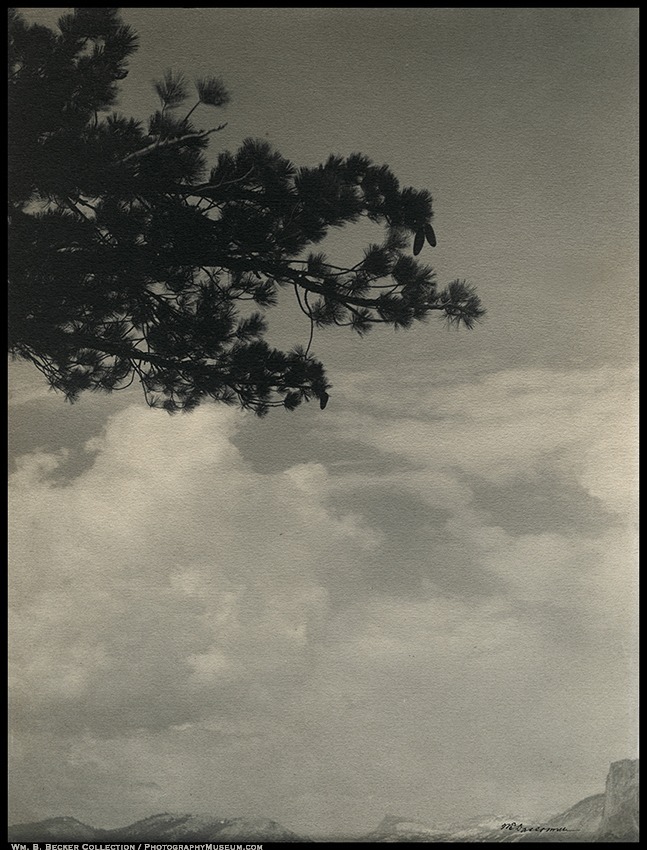
This is not how Yosemite was usually photographed. From the 1860s on, Carleton Watkins, Eadweard Muybridge, and others rendered the valley as a catalogue of monuments — El Capitan, Half Dome, the great falls — all recorded in crisp, full detail and placed squarely in the frame. Dassonville, a San Francisco photographer working in 1905, could have captured the sweeping view from the height of Glacier Point the same way. Instead, he builds a picture out of negative space and a single asymmetrical gesture — the overhanging branch — much as a Japanese print might. The towering mountains below, reduced to the merest line of their crests, may seem like an afterthought, but they create a horizon and establish the great height of the scene.
Dassonville treats the landscape as raw material for design rather than as a subject to be documented, a bold and innovative approach for 1905.
|
|
|
|



Copyright © MMXXVI The American Photography Museum, Inc. All Rights Reserved.“American Museum of Photography” and the logo are Service Marks of The American Photography Museum, Inc.