The Bookstore at The American Museum of Photography(tm): Selected Books on Photography and Photo-History

Jump to: New Books – Ansel Adams – Julia Margaret Cameron — Scott Mutter

|
“A Visual Delight!” |
|
|
|
|


in association with amazon.com
|
|||||||||||

|
|||||||||
|
|||||||||
|
Surrational Images: Photomontages by SCOTT MUTTER — MUSEUM BOOK SHOP BEST-SELLER! I first came across Scott Mutter’s work when we were both in college, more than 25 years ago. We studied photography at the same time, and when I saw his work on the walls of the Fine Arts building, I was dumbfounded. Back then, his darkroom work left a lot to be desired–but his images stood out from a sea of pictures that were technically superior. Here was an alternate world–a real and wonderful place–but clearly one that only Scott could show us. Rather than using the techniques of photomontage for shock effect, from the beginning Scott Mutter put together visual elements in a way that seemed to make more sense than the “real” world. It didn’t take long for Scott to perfect the challenging photographic techniques–often involving multiple enlargers–that enabled him to fully realize his vision. His work is known internationally through a range of print publications including highly successful posters and calendars–and through this book. Surrational Images is a 9″ x 12″ hardcover that reproduces 34 of Scott Mutter’s remarkable photomontages, together with the photographer’s commentaries and an essay by Martin Krause. It is a measure of the book’s success (and Mutter’s popularity) that it has remained in print for seven years, selling out multiple printings. Click on the title above to order at 20% off the list price. For an image by Scott Mutter–the finale of our “Masterworks of Photography” exhibition, please click here.
|
|||||||||
|
This 216 page hardcover is a vital reference–and with a reduced-size carte de visite by Cameron selling for $25,000 recently, it’s as close as most of us will ever get to the experience of owning a collection of original Camerons. To order, just click on the title above. Highest Recommendation!
|
|||||||||
|
|||||||||
|
|||||||||
|
|
|||||||||
|
This book offers 75 of Ansel Adams’ greatest photographs reproduced as full-page duotones. Adams himself selected these images from the photographs that best represent his legacy–famous pictures like “Moonrise, Hernandez” and “Clearing Winter Storm, Yosemite,” but also seldom-seen portraits and near-abstractions like “Surf Sequence–San Mateo County Coast.” The 75 photographs in this collection are known as “The Museum Set,” and make up the final portfolio in which Ansel Adams presented his remarkable life’s work. A beautiful book, with a fine biographical essay by Friends of Photography Director James Alinder. 110 pages, 8-1/2″ x 10-1/4″, hardbound. Click on the title to order at $32.00–a 20% discount from the list price. Or type “Ansel Adams” into the Search Box above for a listing of more than 100 titles by or about this great master of photography! |
|||||||||
|
Silver & Gold; Cased Images Of The California Gold Rush (edited by Drew Heath Johnson) 150 years ago, one of the greatest social upheavals of all time was taking place in the United States: the California Gold Rush. It was among the first major historical events to be recorded by the camera, but until now there has been no book devoted to its images.Silver & Gold is the first book devoted to the photographic documentation of the Gold Rush, bringing together 150+ daguerreotypes and ambrotypes–many never before published. The portfolio of images is impressive indeed–starting off with 50 full-page color reproductions. We see the miners as they set out for the gold fields and after their arduous journey. The camera takes us to the stream-beds and mining camps, to the stores selling gold pans and tobacco, to the rising city of San Francisco. The texts are not to be missed. Drew Heath Johnson provides insights into the role the daguerreotype played in maintaining emotional contact between the dislocated miners and their families far away. Peter Palmquist offers an irresistible tale of the “Daguerreian Holy Grail”–a missing mother lode of Gold Rush daguerreotypes that would be worth millions today. Our friend John Wood–poet and photographic historian–provides a surprising contemporary meditation on greed and hope and the American spirit. And don’t miss the preface by Therese Thau Heyman, who built the splendid photography collection at the Oakland Museum–and who understands, as we do, the significance of the Internet in photo-history:
Of course, there are equally-good arguments to be made for fine photography books–of which Silver & Gold is a perfect example. It brings together a large body of rare and delightful photographs, and complements them with thought-provoking and informative readings. That’s a lot for less than $24. [Silver & Gold is a 264-page softcover, 8.5 x 11 inches. To order, please click on the title anywhere in this review.] |
|||||||||
|
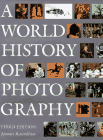
A Must-Have Reference! A WORLD HISTORY OF PHOTOGRAPHY by Naomi Rosenblum
|
|||||||||
|
A TRIUMPH! LIKENESS AND LANDSCAPE: Thomas M. Easterly and the Art of the Daguerreotype Author Dee Kilgo has breathed life back into a long-forgotten photographic pioneer, piecing together bits of documentary evidence and surviving images to reveal Thomas Easterly as a remarkably sensitive and talented artist. Easterly was peculiarly–perhaps even obsessively–dedicated to the daguerreotype process. Long after the public shunned daguerreotypes as old-fashioned, Easterly stubbornly continued making them…. documenting the growth of St. Louis, gateway to the American frontier. His legacy, as presented by Kilgo, is a truly stunning record of Native Americans and mountain men, of outdoor slave auctions and shipwrecks on the Mississippi. Alan Trachtenberg of Yale University says “Easterly is a major figure…and Dolores Kilgo’s book matches its subject in significance. It is simply the most accomplished and most important study of an American artist in photography yet produced.” We heartily agree. 248 illustrations, 63 in color. 234 pages, softbound. HIGHEST RECOMMENDATION! Click on the title to order this great book–just $34.95 for the softcover! |
|||||||||
|
Imagine yourself let loose in a room, given access to some of the finest daguerreotypes in the world. Not just a handful… but box after box….in fact, almost two thousand of them. This happy circumstance for Bates and Isabel Lowry came along with a daunting challenge: choose among them…make a selection from the Getty’s fabulous collection for the world to see in a book. The result is The Silver Canvas, 78 precious images that give us a tantalizing taste of the Getty’s impressive daguerreian holdings. There are some very famous pictures here: the haunting half-plate of Edgar Allan Poe, Mayall’s mamoth-plate of the Crystal Palace, Southworth & Hawes’ dramatic full-plate documenting one of the first surgical operations using ether anesthesia. But the authors have found some unexpected and surprisingly intimate gems by anonymous daguerreotypists: a placid French image of a woman reading to a girl, a luminous portrait of a young American sailor standing beside a barrel, and a tender American scene of a country girl and her pet deer. Bates and Isabel Lowry, both art historians, have done a superb job of researching their 78 choices. In addition to the text that accompanies each plate, there are notes in the back of the book providing further detail and documentation. An essay on the origins of the daguerreotype process is also provided. The Silver Canvas is beautifully designed and printed. One wishes that all of the 78 plates had been printed in full color, but that is a small objection in light of the wonderful opportunity this book provides us to look inside one of the world’s greatest collections of daguerreotypes. Highest Recommendation! 8-1/2″ x 11″, 255 pages, hardbound. Click on the title above to order. |
|||||||||
|
THE PHOTOGRAPHIC EXPERIENCE 1839-1914 by Heinz K. Henisch & Bridget A Henisch Suddenly, the study of photography and society is a hot topic. Even The Wall Street Journal is taking note of the emergence of what’s called “vernacular” photography as a collecting field. The Photographic Experience could serve as a guidebook to this “new” branch of research and collecting–it’s the first comprehensive book on the cultural impact of photography, the result of decades of study by two of our greatest photographic scholars. We see the newly-invented medium quickly invading every facet of people’s lives–as photography was reflected in literature, poetry, music, fashion and the popular press. Even one of Bridget Henisch’s specialties–culinary history–comes into play (the 1862 recipe for “Photographer’s Cheesecake” appears on page 57). There are sections on the camera’s uses in wartime and in world travel, in the criminal justice system and global politics. Everything is carefully researched and the text is clear, thoughtful and entertaining. Then there are the illustrations… hundreds of them. Yes, there are masterpieces here–among them a spectacular daguerreotype of Jenny Lind owned by Britain’s Royal Family. But you’ll also find a neoclassical artwork sculpted from butter, a woman wearing a high-fashion hat that looks like a camera, and President Theodore Roosevelt’s portrait framed in an outhouse seat. And that’s only a hint at the visual surprises in store for readers of The Photographic Experience. 462 pages, 8-1/2 x 11 inches, hardbound. HIGHEST RECOMMENDATION! |
|||||||||
|
THE PAINTED PHOTOGRAPH 1839-1914 by Heinz K. Henisch & Bridget A. Henisch There’s been an explosion of interest in painted and tinted photographs recently; they appeal to collectors of folk art as well as to many photography enthusiasts. The Painted Photograph features 130 illustrations (most in color, of course), including a stunning portfolio of painted oversize tintypes from the Collection of John O. & Libby Parker. The Henisches (see previous review) again provide a warm, entertaining look at their topic, thoroughly researched and accompanied by detailed notes. The Painted Photograph does not skimp on technical information; one of this book’s strengths is its use of period sources to describe a wide range of techniques for retouching, tinting, overpainting and airbrushing. Some of the equipment shown for these pursuits looks as daunting as anything in Dr. Frankenstein’s laboratory, but there were low-tech solutions employed as well. How to get watercolors to stick to the resistant surface of an albumen print? One “expert” advised “apply the tongue to the surface” beforehand. (To which the authors gleefully add,”One more problem licked.”) It’s all here–everything from tinted daguerreotypes to those chalklike enlargements known as “Crayon Portraits.” There’s also a chapter on painted photographs from around the world. 242 pages, 8-1/2 x 11 inches, hardbound. HIGHEST RECOMMENDATION! Click on the title to order this book! |
|||||||||
|
THE ART OF THE AUTOCHROME: The Birth of the Color Photography by John Wood If you haven’t seen this book… prepare to be dazzled. Autochromes were made by the first truly practical process of color photography. After decades of tinkering by inventors and madmen around the world, the Lumiere Brothers of France succeeded where everyone else had failed. Their plates were coated with a simple black-and-white emulsion, together with a layer made up of millions of microscopic grains of potato starch, dyed in primary colors. The end result was a process simple enough for an advanced amateur to use, and capable of producing rich, glowing color photographs on glass. Fine autochromes have been compared to stained glass windows and pointillist paintings. When the Lumieres brought the process to market, Alfred Stieglitz predicted “Soon the world will be color-mad.” Our esteemed friend John Wood offers readers a look inside his personal collection of autochromes, providing examples by Stieglitz and his circle: Eduard Steichen, Heinrich Kuhn, Frank Eugene, George H. Seeley and Paul B. Haviland. Other important photographers represented in The Art of the Autochrome include Arnold Genthe, Karl Struss and Adolf de Meyer, but many of the names behind the most exciting images in this book will be unfamiliar to most readers. There are surpassingly beautiful portraits (and one luminous view of a porch at sunset) from a group of 50 by J. B. Whitcomb. Little is known about this photographer, whose autochromes were rediscovered in 1985. We have more information about the French professional photographer Antonin Personnaz, whose dazzling scenes of harbors and country lanes have a clear connection to the works of Monet. And The Art of the Autochrome presents a selection of wonderful images by Gervais Courtellemont, who published more than 350 autochromes in National Geographic during the 1920s. In all, there are 75 full-page plates in The Art of the Autochrome. A dazzling book and a wonderful gift for anyone who enjoys photography. Highest Recommendation! 200 pages, 8-1/2″ x 11″, hardbound. Click on the title above to order it instantly! |
|||||||||
|
|||||||||
|
We’ll be adding additional reviews and recommendations, and hope you find this feature helpful. Your comments and suggestions are appreciated. Fine print: Savings are based on a comparison with the recommended retail price. Prices listed on this page were current as of 10/31/00 but are subject to change without notice. For books listed in the “Current Titles” section of this page, all transactions take place through the amazon.com website solely between the purchaser and amazon.com and are covered by the terms of amazon.com service agreement. |
|||||||||



Copyright © 2000 The American Photography Museum, Inc.