virginiapoe

|
|
|
|
 |
 |
| |
|
|
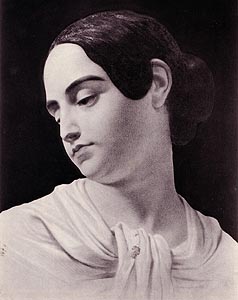
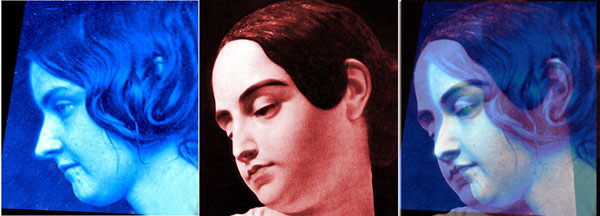
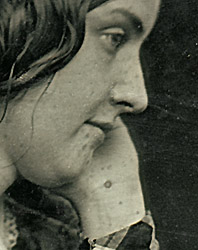
One of the few written descriptions of Virginia Clemm Poe’s appearance, from a friend of the Poes, was published in Harper’s New Monthly Magazine in February of 1889: “Her sole beauty was in the expression of her face. Her disposition was lovely. She had violet eyes, dark brown hair, and a bad complexion that spoiled her looks.” A closer look at the left figure’s face shows what appear to be blemishes on the woman’s chin. This is seldom seen in daguerreotype portraits; presumably sitters with complexion problems would have covered them with makeup. (The spot on the woman’s wrist appears to be a flaw in the daguerreotype plate.) |
| |
| |
 |

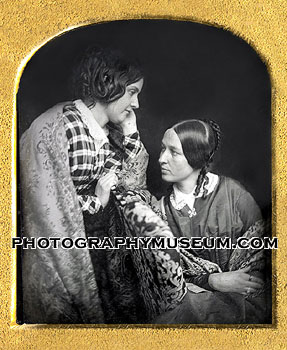
The Southworth & Hawes daguerreotype with the proposed identification of Virginia Clemm Poe and Another Sitter is a quarter-plate ( 3.25 x 4.25 inches) , Collection of Wm. B. Becker. Enhanced digital versions Copyright © MMXI . A high-resolution file is available. For reprint/reposting/licensing/permissions, please click here to email details of your request.
| Date The Southworth & Hawes daguerreotype has a platemark indicating that the J. M.L. & W. H. Scovills Company of Waterbury, Connecticut was the manufacturer of the silvered copper plate on which the image was produced. This platemark, “SCOVILLS”, is consistent with a production date for the plate prior to January of 1850, when the firm incorporated as Scovill Manufacturing Co. and changed its platemark accordingly. American costume historian Joan Severa has analyzed the clothing and hairstyles of the two sitters in the Southworth & Hawes daguerreotype, and concludes that it was made in 1844 or 1845. The most likely date for this portrait would be on or around October 16, 1845, the evening of Edgar Allan Poe’s infamous lecture at the Boston Lyceum. However, Poe also visited Boston on or after July 2, 1845. If the Shew Fits… The woman who nursed Virginia Poe through her final illness was Marie Louise Shew, to whom Poe dedicated at least one poem. She was married to Dr. Joel Shew, a water-cure physician. Four of Joel Shew’s brothers were active in the daguerreotype trade: William, Jacob, Myron and Truman. William and Myron were both working in Boston in 1845– with William’s principal business being the production of leather cases to hold daguerreotypes. In 1847 Myron briefly operated a daguerreotype business at 11-1/2 Tremont Row. The Southworth & Hawes daguerreotype studio was just a few doors away, at 5-1/2 Tremont Row. Certainly both Myron Shew and William Shew would have known Albert S. Southworth and Josiah J. Hawes, who had the reputation of producing the most artistic daguerreotypes in Boston. It is entirely possible that one of Marie Louise Shew’s brothers-in-law could have arranged a sitting for the wife of Edgar Allan Poe. Is the other woman in the daguerreotype Marie Louise Shew? We have been unable to find a good portrait of her for comparison purposes, but it seems unlikely: Mrs. Shew gave birth to a daughter, Alma, exactly one month before Poe’s Boston Lyceum lecture. Provenance This double portrait, titled “A Conversation Piece” by its present owner, was among perhaps 2,000 or more Southworth & Hawes daguerreotypes retained by Josiah J. Hawes in the Tremont Row studio until his death at age 97 in 1901. Some portraits were clearly retained because of the celebrity of the sitters (Daniel Webster, President Franklin Pierce, Jenny Lind as well as some subjects whose fame has since faded out) but the rationale for keeping others, of unknown and presumably unheralded sitters, is uncertain. The children of Mr. Hawes inherited the daguerreotypes upon his death and stored them for three decades. In 1934, Edward Southworth Hawes exhibited and offered for sale a number of images at Holman’s Print Shop in Boston; sales arranged by Holman’s led to significant holdings of Southworth & Hawes daguerreotypes today at the Metropolitan Museum of Art, the Museum of Fine Arts, Boston, and the George Eastman House International Museum of Photography and Film. At an unknown time, but presumably in the 1930s and1940s, a Boston X-ray technologist and collector named David Feigenbaum acquired 288 Southworth & Hawes daguerreotypes. Mr. Feigenbaum’s hoard was rediscovered after his death in 1998 and dispersed at auction (Sotheby’s, New York) the following year. “A Conversation Piece” was one of 21 daguerreotypes of women in Lot 57 of this sale. To some extent, daguerreotypes that were housed together when found in Mr. Feigenbaum’s basement, and presumably were kept together by Josiah Hawes, were grouped into this lot. It may therefore not be a coincidence that a daguerreotype thought to resemble the poet Lydia Sigourney was also acquired in Lot 57, |
| |
|
“Deathbed” portrait: Collection of Mr. Ridgely Bond, Jr. All other content: Copyright © MMXI The American Photography Museum, Inc. All Rights Reserved.
“American Museum of Photography” and the logo are Service Marks of The American Photography Museum, Inc.