Guiding Lights – Cyanotypes of American Light Houses
 |
 |

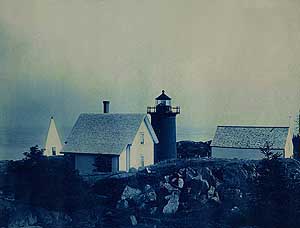
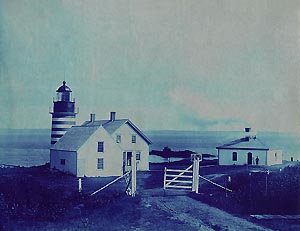
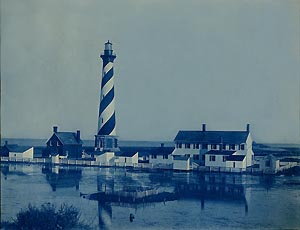
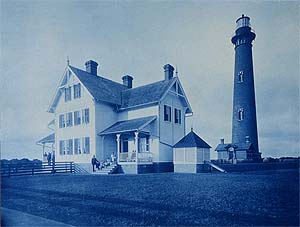
| Although he was an engineer by profession, Herbert Bamber (1858 – 1937) is best known today for making a photographic survey of American lighthouses in 1892 and 1893. Traveling up and down the East coast and around the Great Lakes, he produced hundreds of photographs. Because of their historical importance, Bamber’s surviving glass-plate negatives are now preserved in the National Archives.
Herbert Bamber was born on a family farm in Highland Township, Michigan, about 45 miles Northwest of Detroit. He graduated from Michigan Agricultural College in 1881 and spent a year working for a railroad company in Utah before studying engineering at the University of Michigan. In 1883 he began a long career as an engineer for the US government. Bamber was stationed in Philadelphia, Washington DC and other places, and devoted most of his working life to the US Light-House Establishment. He supervised the construction of the 176-foot lighthouse tower at Mosquito Inlet on the East coast of Florida (later renamed Ponce de Leon Inlet.) That project, completed in 1887, required the placement of more than one million bricks. To aid the construction, Bamber invented an adjustable, moveable “Working Platform” that improved the efficiency of the brick masons– an invention that was adopted for building future brick lighthouses. Operating a lighthouse was a vitally important job. The beacon of light was a life-saver for sailing vessels, helping ship captains to determine their positions and to avoid running aground. But the work could be arduous, especially in bad weather when the beacons and fog warnings were needed most. Even in the best of conditions, lighthouse keepers and their families were usually isolated in remote and rugged areas. Herbert Bamber’s lighthouse photographs show a civil engineer’s eye for detail and order: the images are carefully composed in order to document the layout of each location. Bamber most likely chose the cyanotype process to make his prints because of its simplicity: the amount of equipment needed to print the negatives was minimal and would have permitted him to make prints at the scene in a matter of a few hours. Upon leaving government service, Herbert Bamber returned to his family farm in Michigan. He eventually sold the farm and moved to a house nearby, where he lived until his sudden death in December of 1937 at the age of 79. Bamber never married, but his name lives on today in numerous books and publications that rely on his detailed, orderly photographs to tell the story of America’s lighthouses and the special breed of people who kept the beacons burning through the night. |
||||
|
Click on any image below for a larger view and more information, or click here to view all five in sequence.
|
||||
|
||||
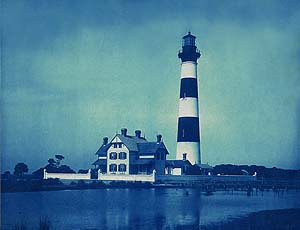 Charleston Light, Morris Island, South Carolina |
||||
|

American Museum of Photography and the logo are Service Marks of The American Photography Museum, Inc. Produced for the web by Becker Information Group LLC