Blue Underground – The Cyanotypes of P. P. Pullis –
 |
 |
   |
||||
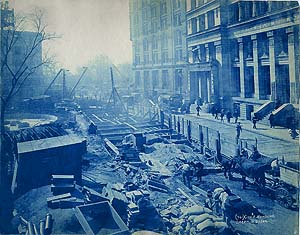
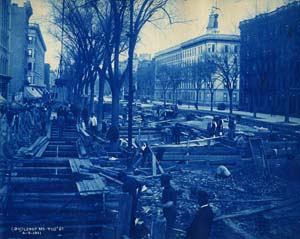
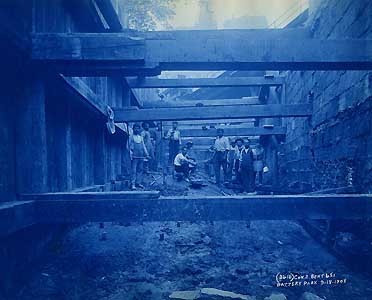
| In May of 1900, in the midst of the cyanotype craze, the New York Times published a brief notice about the appointment of a photographer, P. P. Pullis, to document the building of the New York subway system — a massive project that was just getting underway. The article explained that Pullis would be paid $75 per month for producing “pictures of the work constantly in the process of construction, so that if ever any questions arise, the photographs will be silent witnesses of the truth.” | ||||
| Within seven months, Pierre P. Pullis (1869 – 1942) had taken more than five hundred photographs– the first of many thousands that would follow. Another article in the New York Times noted, “These photographs are an illustrated record of rapid transit work and supplemental, but separate, from the mass of detail drawings. Should at any time complications arise between owners of private property or among the sub-contractors, here is a record that shows in one case the condition of private property that may be affected in one way or another along the route of the road, and in the other, the various stages of road construction.” While ostensibly intended to provide documentation in case of legal disputes, the cyanotypes offer rich details about life on New York’s streets and sidewalks during the early years of the 20th century, as well as fascinating views of the enormous and ambitious engineering project that created the city’s famous subway system. Two prints of each negative were kept on file, one in the offices of the Rapid Transit Subway Construction Company and the other in the office of the Rapid Transit Commissioners. At least some of the negatives were also printed on platinum paper, a more expensive material that is noted for its permanence; these may have been produced for inclusion in presentation albums. Civil Service records indicate Pullis was earning $2100 annually by 1911, more than double his starting salary a decade earlier. In November of 1911, Pierre Pullis’s younger brother Granville W. Pullis was hired as an Assistant Photographer on the project. Pierre Pullis’s photographs of the subway construction appeared in numerous books and magazines; six of them illustrated an article in the New York Times in 1912. The photographs were also the basis for a series of postcards, at least one of which ended up in the collection of the noted photographer Walker Evans (whose postcard collection is now at the Metropolitan Museum of Art.) Little is known of Pierre Pullis’s life outside of his career documenting the subway. He and his wife Margaret had three sons and a daughter. An advertisement in an obscure engineering publication from 1907 gives his business address as 32 Park Place in New York City and succinctly lists his specialties: “Construction Work. Copying Maps, etc. Lantern Slides.” The New York Times, which featured Pullis in two articles during his first year on the job, does not seem to have carried a death notice at the time of his passing, on August 27, 1942. He was 73. Some of Pullis’s subway photographs were discarded or dispersed in the 1970s. Others ended up in the archives of the New York Transit Museum, the Brooklyn Public Library, and other institutions. A few are now finding their way into the collections of major art museums, as Pierre Pullis’s “silent witnesses to the truth” gain recognition for their distinctly modernist approach– documenting a monumental, gritty job in deep shades of blue. |
||||
|
Click on any image below for a larger view and more information, or click here to view all four in sequence.
|
||||
|
||||
|
||||
|


American Museum of Photography and the logo are Service Marks of The American Photography Museum, Inc. Produced for the web by Becker Information Group LLC